
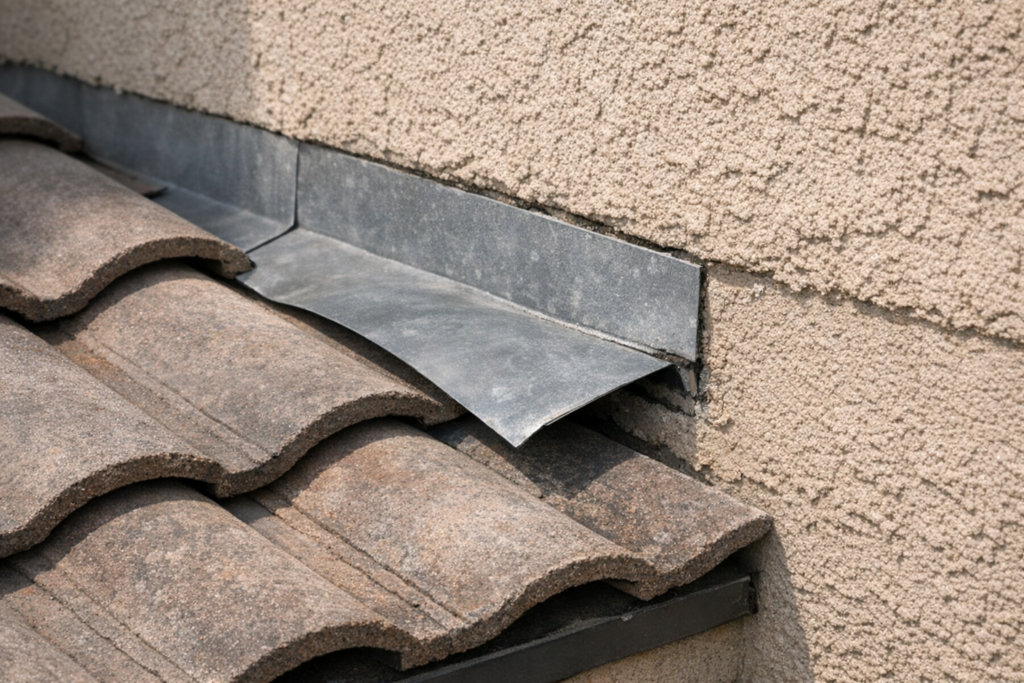
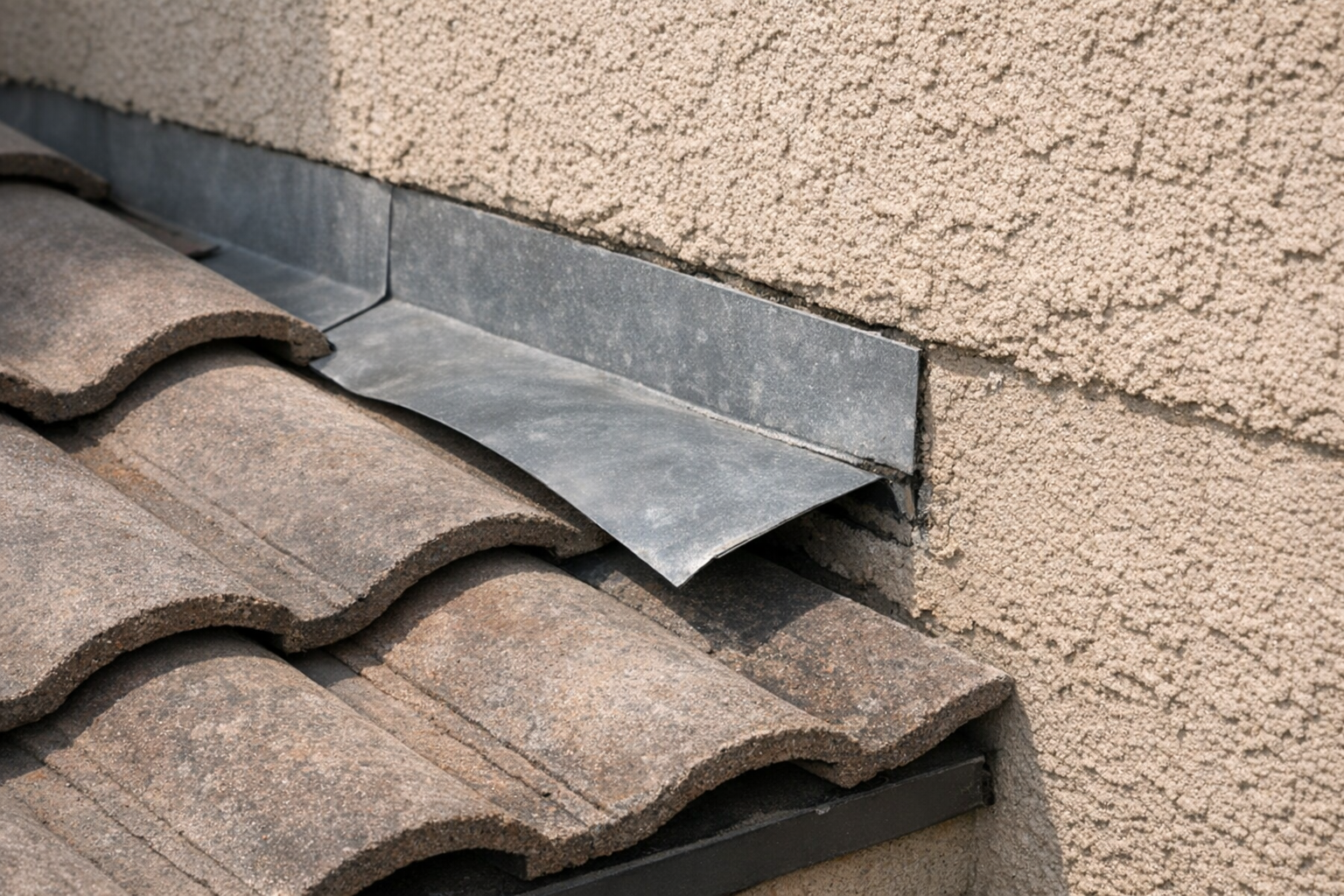
Loose roof flashing in Henderson 89002 deserves inspection when metal lifts, separates from a wall, rattles, or appears beside new water staining. These signs do not establish the leak source, but they justify checking the connection before approving a surface patch. Flashing directs water through vulnerable transitions, including roof-to-wall intersections and penetrations. This guide focuses on metal flashing at a tile roof’s wall junction, with questions for other affected transitions. Observe from the ground or a safe interior location; do not climb onto the roof. The 89002 ZIP is a postal reference, not proof of municipal boundaries or a uniform roof system.
1. Recognizing loose roof flashing in Henderson 89002
At a roof-to-wall junction, flashing works with the roof covering, underlayment and wall detail to direct water outward. Some metal is intentionally exposed; other portions disappear beneath tiles or behind wall finishes. An exposed edge alone is not evidence of failure. What matters is whether the assembly has shifted, opened, lost support or separated from its intended connection.
From a safe ground-level viewpoint, look for a raised metal corner, a new shadow line beneath an edge, an irregular gap at the wall, or metal that appears displaced compared with adjoining sections. A photograph taken before the concern appeared can help establish whether something changed. Do not try to push the metal back into place or test its movement.
- Visible displacement: a section appears lifted, twisted or pulled away.
- Disturbed connections: a visible fastener looks backed out, or an attachment location appears torn.
- Adjacent disruption: a tile has shifted beside the metal, exposing a previously covered area.
- Recurring sound: rattling coincides with wind near the suspected junction.
Sound can travel through a building, so rattling does not prove which component is loose. Likewise, a gap may be part of an intended drainage detail. Ask for photographs and an explanation before accepting a diagnosis. Presto Roofing LV’s roof inspection guidance explains why accessible findings and inspection limitations should be documented together.
2. Decide how urgently the signs need attention
Separate a suspected defect from an immediate safety problem. Metal that looks displaced but remains attached, with no active water entry, calls for a timely inspection rather than a homeowner roof visit. A visibly flapping piece, hanging metal over a walkway, or material falling from the roof requires restricting access below the affected area and contacting a roofing professional promptly.
Inside, photograph new staining from a safe position. Record whether it is dry, damp or actively dripping, and note when it appeared. A stain below a roof-to-wall intersection may support investigating that junction, but water can travel along framing or roof layers. The apparent interior location is not a reliable map of the entry point.
If a ceiling bulges, sags or sheds material, keep people away. Do not puncture it or stand beneath it to collect photographs. If water is near lights, outlets or electrical equipment, avoid contact and obtain appropriate emergency assistance; do not attempt electrical work.
For managers, record the affected unit or room and identify safe access arrangements without sending maintenance staff onto the roof. Keep occupants informed about areas they should avoid. The emergency roof repair guide provides context for urgent roofing concerns.
If the change followed wind or rain, note that timing without declaring storm damage as the cause. The post-storm observation guide can help organize observations. A contractor still needs to distinguish a recent displacement from an older connection problem.
3. Gather useful evidence without disturbing the roof
A useful inspection request describes what changed, where it appears and what remains uncertain. Start with an overall photograph showing the roof section and wall junction. Add a closer image only if a phone’s zoom provides it safely from the ground. Include an interior photograph if there is staining, but avoid entering tight attic spaces or areas with uncertain footing.
Label photographs by viewpoint, such as driveway side or courtyard-facing wall, rather than assuming the contractor will recognize the location. Note when the symptom first appeared, whether it has recurred, and whether wind direction or rain seems relevant. Describe sounds separately from visible damage so the inspector does not treat an assumption as evidence.
- Has anyone previously repaired this flashing or applied sealant there?
- Were tiles, wall finishes or nearby equipment recently serviced?
- Does the concern affect one junction or several separated locations?
- Are roof plans, prior invoices or material records available?
- Who can authorize inspection access and any limited investigative opening?
Do not remove sealant, lift tiles or pull on exposed metal to improve the photographs. Those actions can damage a working overlap or obscure the original condition. Contractors may need controlled access to concealed layers, but that should be discussed before work begins.
For an occupied rental or managed property, consolidate reports into one timeline. Conflicting descriptions can lead to repeated visits to the wrong location. When requesting roofing assistance in Henderson, provide the actual street address as well as 89002 so access and property location can be confirmed.
4. Ask what loosened the flashing, not just how to cover it
Loose flashing is a condition, not a complete diagnosis. Repeated thermal movement, wind loading, deteriorated attachments, damaged support or an unsuitable original connection can contribute. Prior repairs may also restrict movement or conceal an open seam. None of these causes should be assumed solely because the metal looks lifted from the ground.
Ask the inspector to identify which part moved. Is the roof-side flashing displaced, is a wall-side counterflashing connection open, or is the visible sealant separating while the metal remains secure? These distinctions matter because adding material over the surface does not necessarily restore attachment or correct water-shedding laps.
On a tile roof, the visible tiles are only part of the assembly. The inspector may need to assess how the flashing connects with concealed underlayment and whether neighboring tiles are supporting, pinching or striking the metal. Read the tile roof repair overview for context on examining more than the exposed tile surface.
Request a clear explanation of the water path: where water should land, which layer should receive it, and how it should exit. Ask whether the attachment permits movement appropriate to the installed detail. Also ask whether proposed materials are compatible with the existing metal, underlayment and wall finish.
If deterioration extends beneath the flashing, the repair may need a larger opening than the visible gap suggests. The underlayment replacement guide explains why concealed water-shedding layers can change the scope. Photographs should distinguish confirmed findings from areas that remain unexamined.
5. Use inspection questions to compare repair and replacement
A localized repair may be reasonable when the metal remains serviceable, adjacent materials are sound, and the attachment or overlap can be restored correctly. That might involve professionally exposing the connection, correcting support or fastening, and restoring surrounding roof layers. The appropriate procedure depends on the actual assembly, not a universal flashing repair recipe.
Replacing the affected flashing may make more sense if it is torn, extensively corroded, badly deformed or too short to form a dependable connection. Reusing damaged metal simply because it can be pushed flat may leave the original weakness unresolved. Conversely, one loose section does not by itself establish a need for whole-roof replacement.
- What is confirmed? Ask which defects are visible and which require opening the roof.
- What can be retained? Ask why existing metal, tiles or underlayment remain suitable.
- What must be replaced? Request limits by location, not just “repair flashing.”
- What could expand the scope? Ask how concealed damage will be documented and approved.
- What remains outside the repair? Clarify nearby wall, equipment and interior work.
A proposal should distinguish temporary stabilization from a completed repair. A temporary measure may reduce immediate exposure without correcting the underlying detail. Ask what follow-up remains necessary and what limitations apply.
For broader recommendations, request evidence of widespread deterioration or repeated failures beyond this junction. The roof replacement decision guide offers a framework for that discussion. The goal is a justified scope, whether small or extensive, rather than the cheapest visible patch or the largest possible project.
6. Understand the factors behind a flashing repair estimate
Flashing estimates can differ because contractors are pricing different access conditions and different amounts of concealed work. A readily accessible junction is not equivalent to one beneath several tile courses or beside delicate wall finishes. Roof slope, height, safe access arrangements and protection of occupied areas can all affect the work needed.
Ask whether the estimate includes carefully removing and reinstalling surrounding tiles, replacing damaged pieces, restoring underlayment connections and repairing disturbed wall finishes. Some of those tasks may belong to a separate scope or trade. A written exclusion is more useful than an assumption that everything near the flashing is included.
The metal itself also matters. Profile, condition, compatibility and whether a replacement needs fabrication can influence the proposed repair. If sound material is being reused, ask how its suitability was evaluated. If new material is proposed, ask how it will integrate with the existing assembly rather than simply cover it.
Compare the inspection findings behind each estimate. One proposal may address only the visible lifted corner, while another includes opening the transition to inspect concealed damage. Neither description establishes value until the contractor explains why that scope is appropriate.
For suspected leaks, ask how the proposed work relates to the observed interior symptom and what uncertainty remains. The roof leak repair guide discusses tracing entry rather than patching directly above a stain. Request written terms for additional discoveries, cleanup, documentation and any workmanship coverage offered. No price comparison is meaningful if those responsibilities remain unclear.
7. Plan follow-up around the repaired assembly
After repair, request photographs of the completed connection and, where available, the exposed layers before they were covered again. A finished surface photograph may show neatness but not the concealed overlap. Keep these images with the invoice, scope and any product information so a future inspector can understand what changed.
Ask what the contractor observed nearby. A sound flashing repair does not correct every other transition on the roof, and it may not resolve staining caused by a separate source. Record any recommended follow-up, including areas that could not be evaluated during the visit. Establish who will review unresolved interior moisture concerns.
Choose inspection timing according to the installed system, manufacturer guidance, documented condition and property use. Avoid treating one calendar interval as suitable for every roof. A repaired junction, recurring movement or nearby trade work may justify a different follow-up plan from an undisturbed assembly with no reported symptoms.
From the ground, watch for renewed displacement, changed noise or fresh staining. Do not repeatedly touch the detail to check whether it remains tight. Arrange professional assessment if debris collects at the transition; do not add screens, barriers or improvised drainage changes without evaluating their effect on water flow and maintenance access.
Managers should include the repaired location in contractor handover notes before future wall, tile or rooftop equipment work. Presto Roofing LV’s roof maintenance guidance can support that planning. The useful record is property-specific: what was repaired, what remains uncertain, and what observable change should trigger another inspection.
8. Frequently asked questions about loose flashing
Can flashing be loose without a roof leak?
Yes. A displaced connection may not yet have admitted water, or concealed layers may still be directing it away. Rain direction and the location of the opening can affect whether an interior symptom appears. Lack of staining does not prove the flashing is secure, so visible movement still warrants inspection.
Is a bead of sealant enough to repair it?
Sometimes sealant is part of a correctly designed detail, but it should not be assumed to replace attachment, sound metal or proper overlaps. Ask what failed and how the proposal restores that function. A surface application alone may hide a gap without addressing why the metal moved.
Does loose flashing mean the roof needs replacement?
Not automatically. One connection can fail while surrounding materials remain serviceable. A replacement recommendation should identify broader deterioration, unsuitable concealed layers or other conditions that make localized work inadequate. Ask for photographs and a comparison of repair limits before deciding, especially when the recommendation extends well beyond the observed junction.
Can a contractor confirm the cause from my photographs?
Photographs can help identify the likely component and prioritize a visit, but they rarely establish concealed attachment or underlayment condition. Ask which conclusions are preliminary and whether limited opening is needed. Agree on authorization and documentation before investigative work disturbs tiles or wall finishes.
What should a property manager send with the request?
Provide the address, affected building or unit, photographs, symptom timeline, access contact and any previous repair records. Mention occupied areas beneath hanging metal or active leaks. Clarify who can approve investigative work and additional repairs so a useful inspection does not stall over access or authorization.
Keep the request focused on the observable problem rather than diagnosing it in advance. “Metal lifted beside the wall after a new rattling sound” gives an inspector a clearer starting point than an unsupported claim that the entire roof has failed.
Concerned about loose flashing at your Henderson 89002 property? Contact Presto Roofing LV with safe ground-level photographs, the location of the affected junction and any interior symptoms. Request an inspection that explains the connection, documents accessible findings and separates temporary protection from a lasting repair. Discuss the appropriate next step for your roof by calling 702-867-0187.